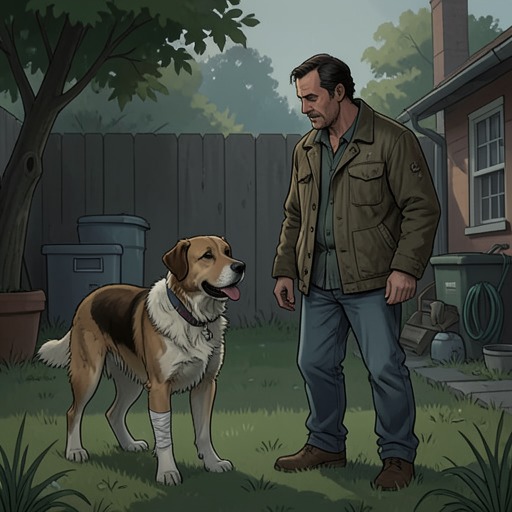
Gavin takes Dutch in as family
A Dog's Way HomeGavin takes Dutch in as family describes a bond formed through a painful reversal: Gavin first tells Kurch that Dutch belongs with his former owner, but when Kurch refuses responsibility, Gavin leaves with Dutch and makes a new home for him. The relationship is not presented as a simple rescue or instant cure for grief. Dutch remains distressed by the loss of Kurch, while Gavin answers that distress with physical comfort, explicit promises, and the practical work of finding care for a dog he has chosen to call family.
From rescue to responsibility
Bella first observes Gavin alongside Dutch in the snow. When people climb onto their machines and drag an injured man away on a sled, Dutch cries out and runs after them in panic. Gavin calls Dutch back, then moves toward the machines; Dutch circles them anxiously and puts a foot on the sled where his person lies. Bella recognizes that Gavin knows Dutch, even though he does not know her. The difference matters to her: Dutch has someone who can look after him, and she can turn her own attention toward finding Big Kitten and following the pull of home and Lucas.
Gavin’s handling of Dutch also appears in a quieter moment after the machines leave. Dutch lunges against his rope, ears back and eyes showing white, while Gavin nearly loses his balance and tells him to stop, sit, and stay. Bella obeys the stay command herself because she can smell bread treats in the pack; Dutch, by contrast, continues to whine and pull. Gavin speaks soothingly to him. The scene establishes an early pattern in their connection: Dutch’s attachment is urgent and physical, and Gavin tries to steady him through presence and reassurance rather than treating his panic as disobedience alone.
Kurch’s refusal and Dutch’s grief
The relationship reaches its decisive turn when Gavin confronts Kurch, who is in bed after the snow incident. Gavin is angry that Kurch refuses responsibility, while Kurch replies that Gavin is trying to leave two large dogs with him. Gavin explains that he and his husband are going to China for six months and that he cannot take care of Dutch on that account; he says Dutch belongs with Kurch, while he will work out what to do with Bella. At this point, Gavin is trying to return Dutch to the person Dutch still regards as his own, not yet claiming him as a permanent member of his household.
Kurch responds with a sneer, comparing Gavin’s dilemma over Bella with his own unwillingness to take Dutch. Gavin falls very still, says that he understands Kurch now, and leaves with Bella. Kurch tells Dutch to get out, saying that the dog makes him feel guilty and that it is not his fault. Bella sees Dutch look back down the hall: he wants to remain with the man who was his person, even as the man angrily rejects him. The exchange makes Gavin’s change of course consequential. It is not a routine transfer between willing caregivers; Dutch’s former home has become a place where he is told to leave.
Dutch follows far behind Gavin, bewildered. In the car, Gavin puts his arms around him, and Bella smells tears on Gavin’s cheeks. Gavin apologizes for what happened and promises that he and Taylor will be Dutch’s fathers and will take care of him. He also includes Bella in the promise of family. Dutch does not put his nose out of the window on the drive home, a small but striking sign of how unlike an ordinary journey this is for him: leaving Kurch has not yet become relief or uncomplicated belonging.
Becoming a family
At home, Gavin makes the change explicit. He kneels, puts his arms around Dutch, and tells him that he is Dutch’s father now, that Kurch’s home is no longer Dutch’s home, and that his home is with Gavin, Taylor, and Bella. He holds and rocks Dutch. Bella understands this action as the giving of comfort, a form of care she has herself offered to others. The scene turns a verbal promise into a physical one: Gavin meets Dutch at ground level and holds him while the dog is still struggling to understand where he belongs.
Gavin continues that care over the following days with treats, attention, and hugs. The sadness does not disappear at once; it seems to seep out of Dutch little by little. That gradual change keeps the adoption from reading as an instantaneous replacement of one attachment with another. Dutch has been rejected by Kurch, and Gavin cannot erase that history. Instead, Gavin offers repeated evidence that the new household will remain available to him.
Gavin later tells Taylor that it seems Dutch understood he was making a choice when he got back into the car. He calls both dogs theirs, for better or worse, and jokes that if they wear out the couch, Taylor can buy another one, along with new chairs and a coffee table. The humor registers domestic commitment in concrete terms: Dutch is no longer merely a dog whose placement must be solved, but one of the dogs whose presence may alter the furniture and routines of their shared home. Gavin is already rubbing his feet against Dutch, who lies sprawled on the couch and gives a contented groan.
Commitment and the problem of care
Gavin’s commitment does not make the practical conflict disappear. He and Taylor are due to spend six months in China, and Gavin says he cannot leave the dogs in a kennel for that period. He considers asking his mother, Sylvia, to look after them, despite Taylor’s apparent reservations about her decorating. Gavin acknowledges that the arrangement is not perfect but argues that, in this case, practical care may matter more than an ideal option. The account establishes Sylvia as a possibility under discussion, not as a confirmed solution.
That unresolved plan gives the relationship its particular shape. Gavin’s promise to Dutch is firm, but it has to be carried through choices about care during an extended absence. He does not treat Kurch’s rejection as permission to pass Dutch onward without thought; instead, he accepts the responsibility and looks for a workable arrangement with Taylor. The contrast between Gavin’s initial attempt to return Dutch and his later declaration of family marks the bond’s development: care begins as a question of where Dutch belongs, becomes a response to the harm of being sent away, and ends this part of the story as a shared commitment whose practical details still need to be settled.